
Driveways, patios, walks and slabs
Concrete Contractors in Bowling Green, KY
Flatwork poured on a solid base, finished for Kentucky winters, and quoted in writing.
- Estimate visits that start with your soil, slope and downspouts
- Every quote broken out: base, thickness, steel, finish and tear-out
- City right-of-way permit sorted out before work near the street
Concrete Built for Bowling Green Ground and Weather
We are concrete contractors in Bowling Green, and most of what we do is the concrete around a house: the driveway, the patio out back, the walk to the front door, a pad under a shed or a spa, and repairs to slabs that have cracked or settled. Bowling Green is Kentucky's third-largest city, with 72,294 people at the 2020 census, and the Warren County area around it grew more than 18 percent between 2010 and 2020. That means a lot of new driveways in new subdivisions and a lot of older concrete in established neighborhoods that is starting to show its age.
What makes concrete in Bowling Green different
Two things decide how a slab should be built here: the ground it sits on and the weather it sits in.
Ground. The city is on limestone karst, the rock that hollowed out Lost River Cave, and Kentucky Geological Survey figures put more than half the state on karst. In April 2025, after a storm system dumped more than ten inches of rain, Bowling Green dealt with at least 18 fresh sinkholes. The city geologist told WKU Public Radio that soaked clay gets heavier and more plastic and breaks more easily, and that out toward Russellville Road and Nashville Road the caves carrying water are often 15 to 20 feet below ground or less. A patio does not need a cave under it to have trouble, though. Clay that softens in a wet spell and drains slowly is enough to let a thin or loosely packed base sink.
Weather. Expect roughly 47 inches of precipitation a year, about 41 days of 90-degree heat, and January nights that average in the upper 20s. Snowfall is modest, around 8 inches, but the thermometer crosses 32 degrees over and over each winter. Ahead of storms the city sprays brine on streets and follows with salt. Moisture that gets into a concrete surface freezes, swells and pops off thin flakes, and salt speeds that up. That is why outdoor slabs here should get an air-entrained mix, a finish that is not overworked, a real cure and a sealer.
Older concrete and newer concrete
The median home in Bowling Green was built around 1991, based on Census survey data summarized by Point2Homes, and roughly six in ten homes are older than 2000. A driveway poured in the 1970s or 1980s has been through decades of freeze-thaw, tree roots and settling. Common problems are cracked and sunken sections at the garage or the street, flaking surfaces, and walks that heave where they meet the yard. Newer homes from the 2000s and 2010s have their own issues: builder-grade slabs on fill that settles, patios that were never sealed, and driveways too narrow for two vehicles and a trailer.
Our build sequence
- Strip and shape. Sod, topsoil and any mushy clay come out until we reach firm subgrade. The grade is set so rain leaves the slab and heads away from the foundation.
- Stone base. Crushed stone is spread in lifts and each lift is compacted. On clay, this layer does more to prevent sinking and rocking than extra concrete thickness.
- Steel. Rebar or mesh sits on chairs near mid-depth, where it can hold cracked sections together, not down in the dirt.
- Mix and finish. Exterior pours use air-entrained concrete. Drives and walks get a broom texture for traction; patios can take a stamp and color.
- Joints and cure. Saw cuts or tooled joints go in at a spacing matched to the slab thickness, giving shrinkage cracks a straight path. The surface is kept from drying too fast while it gains strength.
- Seal. Once cured, a penetrating or film-forming sealer slows down water and salt.
Permits and the city right-of-way
If a project touches a city street, curb, gutter or sidewalk, the City of Bowling Green requires a right-of-way work permit from the Public Works Department's Planning and Design Division. The city's permit page lists a $75 fee per approved application and asks for the application at least 24 hours before work starts. Driveway aprons at the street and sidewalk replacements often fall into that category. Work entirely on your own lot is different, and if you live in Plum Springs, Smiths Grove, Franklin or another nearby town, the rules belong to that city or county. We check before we schedule.
What a Bowling Green concrete job costs
Published national guides are a fair place to start. HomeGuide's ranges run $6 to $15 a square foot for an installed driveway, $4 to $12 for a plain patio, $9 to $30 for a stamped one, and $7 to $17 for a sidewalk. Raising a sunken slab is usually cheaper than replacing it; HomeGuide's mudjacking guide lists $4 to $9 a square foot. Every service page carries a cost table with its source named. The figure that counts is the one on your written estimate, and it moves with tear-out, truck access, base depth, slab thickness, steel and finish.
Our Concrete Services
Six kinds of concrete work for Bowling Green homes, from new driveways and stamped patios to fixing slabs that have cracked or sunk.
Concrete Driveways
New and replacement concrete driveways with a compacted stone base, rebar or mesh, an air-entrained mix and a broom finish that grips in winter.
Learn more →Concrete Patios
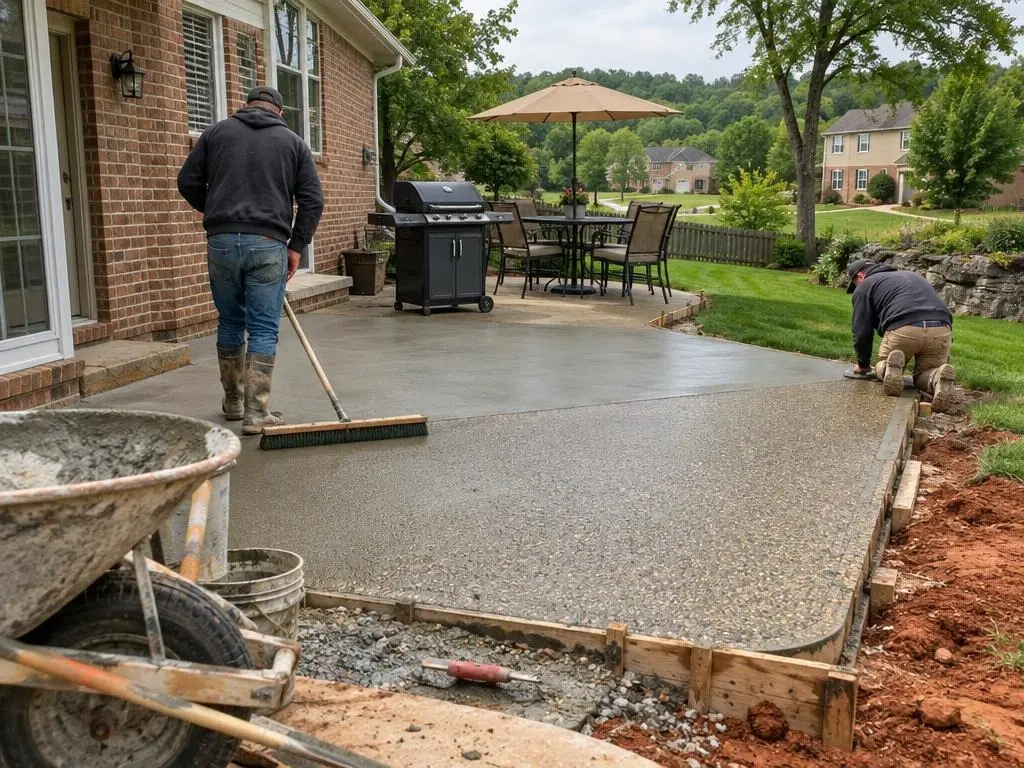
Broom-finished, exposed aggregate or colored concrete patios, sloped away from the house and sized for grilling, seating and shade.
Learn more →Stamped Concrete
Patterned and colored concrete for patios, walks and drives, with slate, flagstone and brick textures, sealed for Kentucky winters.
Learn more →Sidewalks & Walkways
Front walks, side paths and city-side sidewalk replacement, poured level, sloped to drain and joined cleanly to steps and driveways.
Learn more →Concrete Slabs
Pads for sheds, garages, shops, hot tubs, HVAC units and carports, sized and reinforced for what will sit on them.
Learn more →Concrete Repair
Crack filling, patching, resurfacing and leveling for driveways, walks, patios and steps that are cracked, flaking or sunken.
Learn more →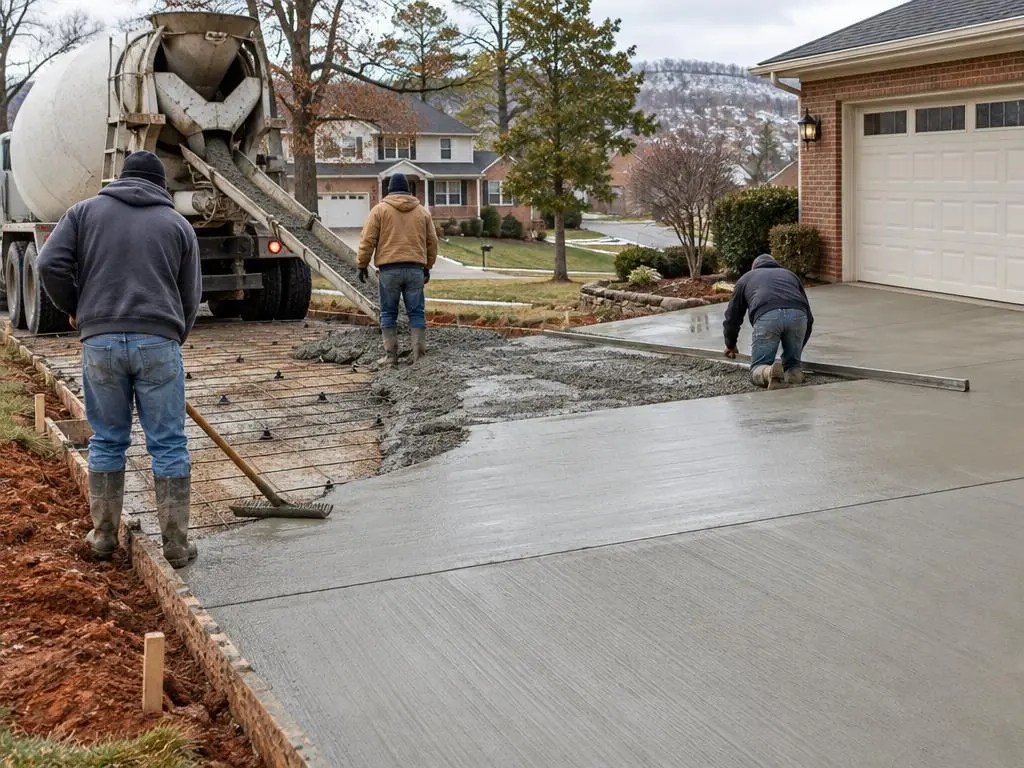
Where We Work
Most of our work is inside Bowling Green, from the older blocks around downtown and Western Kentucky University to newer streets off Scottsville Road and Nashville Road. Right around the city we pour in Plum Springs, Bristow and Plano, in Rich Pond down Nashville Road, Alvaton out US 231, Rockfield out Russellville Road, Woodburn toward Franklin, and Richardsville and Hadley north of the river. Up I-65 are Oakland, Smiths Grove, Park City and Cave City, with Glasgow farther east; west and south are Russellville, Auburn, Franklin and Scottsville; and up the Green River are Brownsville and Morgantown. Older towns lean toward steps, walks and repair, growing ones toward patios and wider drives, and farm lots toward long aprons and outbuilding slabs. Permit rules change from one city or county to the next, so we look up the ones for your address.
- Concrete Contractors in Bowling Green, KY
- Concrete Contractors in Plum Springs, KY
- Concrete Contractors in Bristow, KY
- Concrete Contractors in Plano, KY
- Concrete Contractors in Rich Pond, KY
- Concrete Contractors in Smiths Grove, KY
- Concrete Contractors in Oakland, KY
- Concrete Contractors in Woodburn, KY
- Concrete Contractors in Alvaton, KY
- Concrete Contractors in Rockfield, KY
- Concrete Contractors in Richardsville, KY
- Concrete Contractors in Hadley, KY
- Concrete Contractors in Franklin, KY
- Concrete Contractors in Scottsville, KY
- Concrete Contractors in Russellville, KY
- Concrete Contractors in Auburn, KY
- Concrete Contractors in Glasgow, KY
- Concrete Contractors in Park City, KY
- Concrete Contractors in Cave City, KY
- Concrete Contractors in Brownsville, KY
- Concrete Contractors in Morgantown, KY
Why Homeowners Call Concrete Contractors Bowling Green
We look for dips before we dig
On Warren County karst, a sagging spot in the yard can mean soil draining into rock. We walk the lot for depressions and soft ground, and a new sinkhole goes to Public Works before any concrete does.
Downspouts are part of the quote
Most sunken walks and drives here trace back to roof water softening clay at one edge. Where a downspout empties beside the new slab, the estimate says so and shows the fix.
Salt-season concrete
The city brines and salts streets before ice, and tires carry it home. Driveways and walks get entrained air, an unforced finish, a full cure and sealer to resist flaking.
Every line priced separately
Tear-out, stone depth, slab thickness, steel, finish, sealer and any right-of-way permit each get a line, so two quotes can be compared item by item.
Common Questions
How much does a new concrete driveway cost in Bowling Green?
$2,400 to $6,000 is HomeGuide's range for a 20' x 20' two-car slab, which works out to $6 to $15 a square foot installed. Breaking out and hauling off an old driveway runs another $2 to $6 per square foot in the same guide. Your price comes in writing once we have measured and looked at the base and drainage.
How do I find an affordable concrete contractor in Bowling Green?
Line up two or three written quotes and set them side by side: slab thickness, stone base depth, steel, finish, sealing and removal of old concrete. A low number often means a thinner slab or less base work, and on Bowling Green clay that is exactly where cracks and sinking begin.
Does sinkhole or karst ground affect a concrete driveway or patio?
It can. Bowling Green sits on limestone karst with clay soil on top, and wet clay gets softer and heavier. Most slab problems here come from a weak base and poor drainage, not from caves. If you see a new depression or hole near a slab, report it to Bowling Green Public Works before any concrete work is planned.
Is a permit required to replace a driveway apron or sidewalk in Bowling Green?
Work that touches a city street, curb, gutter or sidewalk needs a right-of-way work permit from Bowling Green Public Works. The city's fee is $75 per approved application, and the request must be filed at least 24 hours before work starts. We confirm what applies to your address before a date is set.
What is the difference between ready-mix concrete and bagged concrete?
Ready-mix is batched at a plant and delivered by truck to a mix design, which lets us order air entrainment and the right strength for outdoor work. Bagged concrete is mixed on site and fits small jobs like post holes or a step. Driveways, patios and slabs are poured with ready-mix.
Should I repair or replace cracked concrete?
Narrow cracks on a slab that is still flat can be filled, patched or resurfaced. Panels that dropped but stayed in one piece are candidates for leveling. Once concrete is broken into chunks, heaving, or crumbling over most of its surface, replacing it is the better use of money.
When can I walk and drive on a new slab?
Foot traffic is usually fine after 24 to 48 hours. Give a car about a week, and heavier trucks longer than that. Cold weather slows the cure, so we set the timing for your pour based on the mix and the forecast.
Get a Concrete Estimate
Free on-site estimates across Bowling Green and the surrounding counties.